
Illegal Gun Possession Charges in New Jersey: Laws, Penalties, and Defense

Among U.S. states, New Jersey enforces among the strictest firearm regulations; law enforcement here pursues illegal weapon charges with consistent intensity. Typically, carrying a handgun without authorization results in a second-degree criminal charge which carries a prison term ranging from five to ten years. Often, such offenses trigger application of the Graves Act, activating required minimum sentences that block early release on parole for extended periods. For those accused, time served must meet fixed thresholds prior to any consideration of release.
Charged with unlawful firearm possession? Start treating it as critical right away because penalties ripple well past jail time. A skilled defense lawyer might uncover if officers overstepped during detention, examination, or apprehension. Evidence flaws and strategies emerge through careful review of procedural gaps. Reducing harsh outcomes in New Jersey weapon cases frequently depends on early, sharp legal navigation.
What Constitutes Illegal Gun Possession Under New Jersey Law
Getting a gun in New Jersey usually starts with paperwork. A Firearms Purchaser Identification Card, known as an FPID, is needed just to buy long guns or ammo. For handguns, another step follows: one separate permit per weapon. Walking around with a loaded pistol off private property? That demands yet another approval, a carry license. Such permissions have always been tough to secure. Even now, despite legal shifts at higher levels, access stays tightly controlled.
Surprisingly, owning a gun might be illegal even if the weapon was acquired lawfully. In New Jersey, simply lacking the correct state permit can make possession a crime. Sometimes, it comes down to whether someone fits within an exception written in N.J.S.A. 2C:39-5. People who relocate from states with looser regulations frequently run into trouble here.
A person carrying legally in Pennsylvania might find themselves detained upon entering New Jersey, even without breaking local laws beforehand. That same situation applies in Florida or Texas: out-of-state permission means nothing once the border is crossed. Without New Jersey’s authorization, possession becomes a criminal matter instantly. Rules from other regions simply do not transfer here. For more on this issue, see our overview of out of state guns in New Jersey.
Home ownership does not guarantee legal protection when possessing a firearm. Another common misconception is that possession inside one’s own home is automatically lawful. While New Jersey provides certain exemptions for possession in the home, firearms that are improperly transported, unlawfully acquired, or possessed outside statutory exceptions can still lead to serious criminal exposure. Prosecutors and law enforcement agencies take these cases aggressively, and even otherwise law-abiding gun owners can suddenly find themselves facing second-degree felony charges carrying mandatory prison exposure under the Graves Act.
Types of Unlawful Firearm Possession in NJ
Registered Yet Illegally Possessed
Carrying a registered gun without the proper documentation is a problem. Even if the weapon was bought legally and comes with full paperwork, issues appear when possession breaks state rules. Imagine having a proper Firearms Purchaser ID with the paperwork complete, purchase done right, but lacking carry permission. That gap between owning and carrying sparks legal trouble fast. Another scenario unfolds when a registered firearm enters places like schools, courts, secure zones of airports, or specific public offices. Rules tighten sharply near those locations, regardless of prior approval elsewhere. The context reshapes everything; ownership alone offers no protection under these conditions. A weapon inside a car, when held without proper legal permission or an active carry license, may lead to severe penalties. Simply put, location matters and registration alone does not prevent illegal possession if transport rules are ignored.
Unregistered Firearms
Some instances deal with guns never registered legally within New Jersey. People often bring firearms into the state after relocating from different states where ownership was permitted. Inherited arms transferred across generations show up in these cases too — for more on this, see our page on inheriting firearms in New Jersey. Private transfers done outside federal dealer oversight break state rules just the same. Without a recognized permit tied to New Jersey law, charges under N.J.S.A. 2C:39-5 appear regularly. It surprises many to find out prior legal status elsewhere means almost nothing locally. At times, just having an unregistered handgun at home can lead to prosecution, especially when how it was obtained does not fit within the law.
Defaced Firearms
Most times, New Jersey takes strict action when dealing with defaced firearms that have scratched-off serial numbers. If someone erases or tampers with a gun’s identifying mark, it counts as its own crime under state code 2C:39-3(c), labeled a third-degree charge. Some behaviors tied to these modified guns drop down to fourth-degree status and penalties might include nearly a year and a half behind bars. Authorities tend to link wiped serials to illegal acts since those codes help track where weapons come from. Often, prosecutors claim regular people following the rules would never need a firearm missing its original ID stamp.
Stolen Firearms
Firearms taken without permission add further legal risk. When a gun is reported missing, whether in New Jersey or elsewhere, authorities commonly pursue extra penalties under theft-related laws along with those tied to unlicensed ownership. Often, if the item’s worth goes beyond $500, holding stolen guns falls under third-degree charges. To secure a conviction, evidence usually needs to show the accused understood the weapon had been unlawfully obtained. Context plays a key role here: unusually cheap deals, cash-only exchanges, tampered identifiers, or having several prohibited arms may support claims of knowledge.
One category doesn’t block another. It is common for a gun to be both taken without permission and have identifying marks removed at the same time. In such cases, legal consequences grow much harsher. Facing several serious charges at once often leads to longer prison terms. Because of the mix of factors, those accused tend to face stronger claims of deliberate wrongdoing instead of simple regulatory lapses.
Charges and Penalties for Illegal Gun Possession in New Jersey
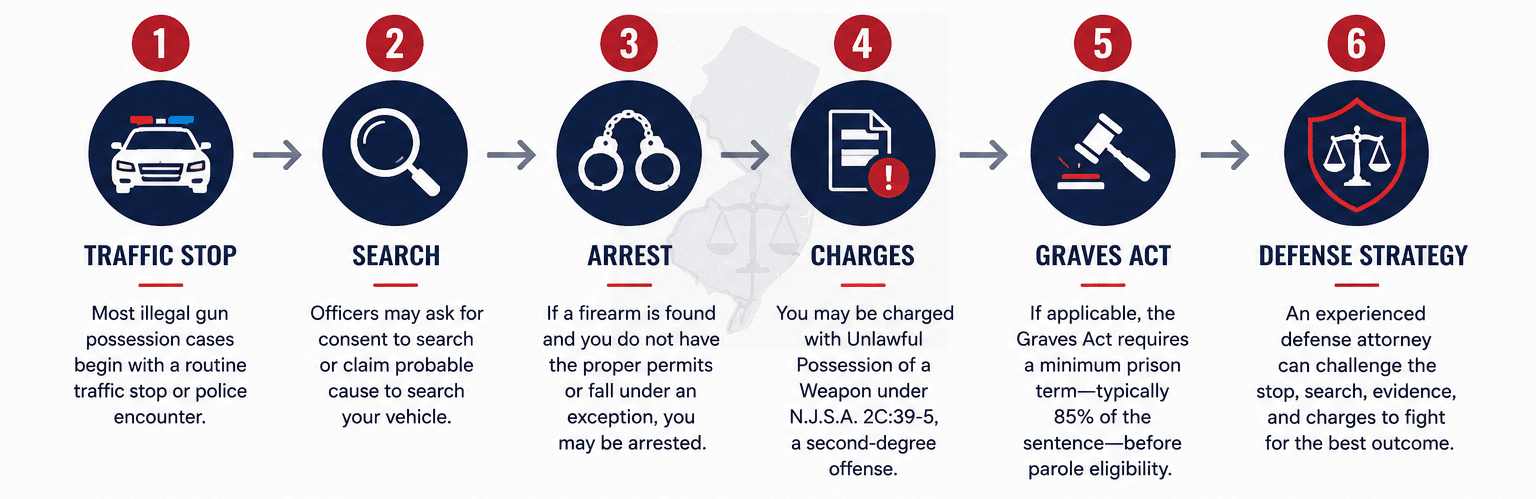
In New Jersey, how a person gets charged for having a weapon illegally often depends on what kind of gun it is. If someone possesses a handgun unlawfully, that offense typically becomes a second-degree charge under N.J.S.A. 2C:39-5. Prosecutors tend to pursue these gun-related cases with strong emphasis. The punishment could mean spending between five and ten years inside a state prison facility. Often enough, the Graves Act comes into play here. When it does, release on parole cannot happen until after serving a set portion of the sentence first.
Facing jail time usually follows unlawful ownership of a long gun, classified most times as a third-degree offense. While not viewed as harshly as carrying a handgun, consequences still weigh heavily under law. Prison terms range from three to five years, plus lifelong legal marks and banned access to weapons. Cases move forward especially if authorities find rifles or shotguns moved carelessly, held missing proper ID paperwork, or uncovered by chance during vehicle inspections or investigations.
Banned assault weapons or machine guns draw especially tough penalties in New Jersey. Second-degree charges often apply, bringing a five- to ten-year prison term. Strict prohibitions cover numerous models labeled as assault weapons. A weapon permitted by U.S. standards or allowed elsewhere might still lead to severe prosecution when found within New Jersey state lines.
Most weapons of certain types face near-total bans, no matter permit status or who owns them. Holding a shortened shotgun, sound suppressor, altered gun serial number, high-capacity magazine, or similar prohibited weapon or device can lead to third- or fourth-degree charges. Charges often stack with illegal possession counts when prosecutors build cases, raising potential penalties. Though rules differ slightly by jurisdiction, overlap between banned tools and harsh outcomes remains consistent across the state.
Fines tied to gun crimes hit hard. Up to $150,000 might follow a second-degree firearm conviction, along with jail time. Court costs pile on top — assessments required by law, payments to crime victim funds, charges for lab work, neighborhood safety fees, and supervision expenses during probation. Even once release comes, the bills often remain. For a full breakdown, see our page on penalties for gun charges in New Jersey.
How the Graves Act Affects Mandatory Sentencing in NJ Gun Cases
Among the toughest consequences of unlawful firearm possession in New Jersey is how the Graves Act comes into play. This law mandates fixed prison terms for numerous gun-related crimes listed in N.J.S.A. 2C:43-6(c), reducing judicial flexibility when handing down lighter punishments. When triggered, it forces courts to assign a set minimum jail period prior to any chance of parole. Though judges may wish otherwise, their discretion fades once the statute activates.
Should someone face second-degree unlawful handgun possession, the law can impose a five-year prison stretch under the Graves Act, keeping parole at bay until that time passes. A third-degree offense involving guns could mean mandatory jail time too, typically locking in at least three years before release becomes possible. Even without past convictions or plans to misuse the weapon, these rules still take effect. How harsh it gets depends on how the events unfold and what judgment is handed down.
Holding a weapon illegally might mean several years behind bars, even when your prior record is clean. Courtroom decisions sometimes reflect discomfort with how fixed these penalties are. Still, judges lack the power to reduce sentences under the required minimums without approval. That exception usually hinges on whether the prosecuting attorney supports a Graves Act waiver.
A person might receive a lighter punishment under a Graves Act waiver when certain conditions exist. Each county’s approach differs, influenced also by what the defense team shows regarding the reasons for leniency. Someone without so much as a parking ticket could have an advantage. The waiver application is submitted to the prosecutor, who will decide the merits of the request.
Additional Weapons Charges Commonly Filed Alongside Gun Possession
Charges tied to illegal guns in New Jersey often come with extra penalties. Alongside the main accusation, authorities commonly add other weapon-related crimes that deepen legal consequences. These added counts tend to extend potential prison time. With more at stake, reaching an agreeable courtroom outcome grows harder.
Among related crimes, unlawful gun ownership stands out under N.J.S.A. 2C:39-7. People previously convicted of felonies face restrictions, along with those subject to restraining orders or found guilty of domestic abuse. Drug-related charges can also trigger the ban, as do certain court-ordered mental health placements. Being caught with a firearm in such cases typically leads to prosecution at the second-degree level. Mandatory jail time follows upon conviction due to Graves Act requirements. Law enforcement tends to emphasize the identity of the holder instead of how the weapon was obtained.
Prosecutors pursue the possession of a weapon for unlawful purpose if signs point to using the gun improperly toward someone or something. Instead of just focusing on ownership, they build their case through context: what was said, actions taken, hints of gang ties, or behavior at the time law enforcement stepped in. Because intent matters so much here, what might seem like a routine violation quickly shifts toward claims of aggression.
Sometimes, weapons charges come with extra counts tied to ammo rules. In New Jersey, owning specific types of bullets or gear — like hollow point bullets used illegally, armor-piercing rounds, or high-capacity magazines — is tightly controlled. Prosecutors might add these counts even without clear evidence of violence. Facing more charges often shifts the balance in discussions before trial. Pressure builds not from one charge alone, but how they stack together.
Carrying guns in vehicles often leads to legal trouble. Under New Jersey rules, moving a firearm from one approved place to another requires specific handling. If the gun is within reach while driving, not secured properly, or moved without meeting narrow exceptions, it may result in prosecution, regardless of whether the person has valid ownership rights. See our guide on transporting firearms in New Jersey for the full legal requirements.
When a gun is listed as stolen, courts frequently seek added charges tied to possession of stolen goods under N.J.S.A. 2C:20-7. Usually, it falls on the prosecution to show the person either knew or had strong reason to believe the weapon was taken unlawfully. Oddities in how the firearm changed hands tend to become key points during such arguments.
When multiple charges are filed together, the consequences become dramatically more severe. A defendant may suddenly face stacked second and third degree offenses, multiple Graves Act mandatory minimums, and decades of combined sentencing exposure. Additional charges also strengthen the prosecution’s negotiating position and increase the likelihood of substantial prison time if convicted.
Who Is Prohibited From Possessing a Firearm in New Jersey
Among those living in New Jersey, some face strict limits on owning guns or similar tools of force. This restriction comes from a state rule known as N.J.S.A. 2C:39-7, which blocks particular groups without exception. While written in wide terms, its aim remains clear — keeping weapons away from people deemed unfit by legal standards. Once listed, access ends, regardless of context or timing.
Years-old court rulings count just the same under state law. Anyone found guilty of what New Jersey classifies as an indictable crime falls within reach of these rules. A single past case, no matter how far in the past, can block gun ownership forever, unless erased legally or rights come back by rare exceptions. Surprisingly often, people learn too late that even nonviolent records may lead to charges. Convictions without any link to harm still activate strict penalties.
Even those found guilty of specific low-level domestic violence offenses face legal restrictions under the law. A person in New Jersey might lose gun rights permanently after a minor conviction tied to domestic abuse. While such an order is in effect, owning a firearm could be forbidden for someone under a restraining decree. Learn more about how this intersects with seizure of weapons in New Jersey domestic violence cases.
Some people lose their right to own guns after being placed in mental health facilities, depending on New Jersey rules. When someone has been judged by a court as having specific psychological issues, gun ownership might no longer be allowed, unless that person goes through an official reinstatement procedure later. Serious attention comes from judges and legal officers since such limits aim to protect others around them.
When a person has struggled with substance misuse, owning a gun might be restricted under specific conditions. In some instances, prosecutors point to medical records showing past rehab stays or ongoing dependence when arguing against granting firearm permits or during legal proceedings about weapon possession.
Minors under the age of 18 are generally prohibited from possessing firearms except in narrow situations such as supervised hunting activities, competitive shooting, or other limited statutory exceptions. Even then, strict compliance with New Jersey law is required. See our overview of children and firearms in New Jersey for details.
Most times, one person’s illegal act gets treated like another distinct second-degree offense alongside the original gun possession charge. This setup allows prosecutors to bring several high-level criminal counts based on just one weapon. With Graves Act penalties often applying, punishment ranges grow much larger without warning.
Most crucially, showing the firearm served an illegal purpose isn’t required by law. Instead, just being near a gun, holding it or even controlling access, can lead to charges for someone barred from owning one. Notably, New Jersey counts two forms: actual possession and constructive possession. So, legal action might follow provided awareness and authority over the item exist. Often, weapons kept in common spaces — such as a car, dresser drawer, guest room, or trunk — can form sufficient grounds.
How Illegal Possession Cases Typically Begin in New Jersey
Most illegal gun cases in New Jersey start unexpectedly, not always with raids or investigations, but during everyday traffic stops. A warning for going too fast, an issue with darkened windows, even just a cracked tail lamp might bring someone to a halt. During these moments, if officers find a weapon while checking the car, things shift rapidly. Discovery of a firearm often leads to closer scrutiny. Should it appear the person does not have proper state authorization, an arrest can be made.
Most people who move to New Jersey come from places where owning guns is less restricted. Take someone from Pennsylvania, Florida, or Texas, where firearm rules aren’t as stringent — they might think their current documentation still applies after crossing state lines. But bringing handguns, high-capacity magazines, or specific long guns into New Jersey without following local statutes turns legal ownership into a crime overnight. Our page on out of state guns in New Jersey covers this in detail.
Weapons offenses often appear during probes into family conflicts. When authorities respond to such calls, they can confiscate any guns found on site. As law enforcement inspects those items, expired permits, illegal models, high-capacity magazines, or ownership by individuals banned under state code 2C:39-7 might spiral toward serious firearm-related charges.
Some cases arise from stop and frisk encounters or street investigations where officers claim they observed suspicious behavior or believed a person was armed. These encounters often produce constitutional issues involving unlawful searches and seizures, which experienced defense attorneys carefully examine when building a defense strategy. See our page on challenging probable cause for a traffic stop in gun cases.
When officers carry out search warrants tied to different crimes, they sometimes come across guns. A home searched for narcotics, burglary items, digital files, or similar issues might reveal hidden weapons instead. These findings often lead to additional legal consequences beyond the original reason for entry.
Security checks at airports and entrances to public offices often lead to unexpected legal issues. Arriving with a firearm inside a suitcase, rucksack, or hand baggage may seem acceptable under national travel policies, but trips across state lines reveal conflicting local laws. Some individuals enter court facilities, educational institutions, or secured zones without realizing such areas prohibit weapons entirely, turning routine situations into potential violations.
Buying a firearm without following official steps might lead to illegal possession charges. When individuals sell guns privately or transfer them casually, skipping those measures, they could face legal consequences.
Heirloom guns can land relatives in legal trouble. Following a loved one’s passing, weapons are commonly handed off quietly, but New Jersey demands official steps like paperwork, licenses, or third-party dealers during such exchanges. Stored away, these firearms might remain untouched for ages until someone realizes just having them could be breaking the law. Review our guide on inheriting firearms in New Jersey to understand the required process.
Surprisingly, most people charged with illegal guns in New Jersey aren’t repeat offenders or threats to public safety. Instead, they’re often lawful gun owners from other states unaware of how strict New Jersey’s rules are about possessing, moving, storing, or carrying firearms. Despite good intentions, ignorance of the law carries no weight in court, and prosecutors move forward anyway.
Defense Strategies for Unlawful Firearm Possession Charges in NJ
Starting a defense in New Jersey for illegal gun possession usually means looking closely at how officers found the weapon. A frequent approach questions whether the Fourth Amendment was broken during the encounter. Should authorities have made an unjustified traffic stop, searched without cause, swept a car improperly, or entered a residence without a warrant, the attorney might push to remove the seized items. Evidence tossed out on constitutional grounds can leave little for the state to build its argument upon. See our full overview of defenses to NJ gun charges.
It is often argued that the person simply did not know. To convict, authorities usually need to show awareness of the item’s presence. When living together, using someone else’s car, or being part of a gathering, one might genuinely say they were unaware. Situations like these tend to happen if the gun turns up inside storage spaces used by more than one individual. It is important to note that one’s proximity to a weapon does not show intention or active possession.
Prosecutors in New Jersey tend to build cases around constructive possession, arguing access and purpose matter more than physical hold. Often enough, defense lawyers counter by pointing to clear links between the weapon and a different person — ownership, handling, decisions made. That shift in responsibility becomes key when proving who truly called the shots.
Occasionally, individuals facing charges might find safeguards through a federal rule known as the peaceable journey clause in the Firearm Owners Protection Act. When moving a gun across state lines between places where owning it is permitted, the national guideline could take effect, so long as the firearm is locked away properly and handled according to set regulations.
Mitigation Strategies
Though proof might seem solid, cutting penalties sometimes hinges on smart legal moves. Getting around automatic jail terms could depend on winning a Graves Act waiver under N.J.S.A. 2C:43-6.2. If it works, prison time shrinks sharply. Effective waiver applications often focus on factors such as lawful ownership in another state, lack of criminal history, cooperation with police, military service, strong employment history, or evidence the firearm was possessed for protection rather than criminal activity.
Some people might qualify for Pre-Trial Intervention (PTI) in rare cases. Completing a supervised program can keep certain defendants from being convicted of a crime. Still, having a second-degree gun charge makes entry much harder. Approval usually depends on the prosecutor agreeing. A guilty plea is typically needed just to be reviewed.
At times, a defense lawyer might work out an agreement to reduce charges so mandatory sentences do not apply. When there are clear issues in the prosecution’s evidence or compelling reasons to lessen penalties, prosecutors can accept changing more serious charges to less severe ones. Sometimes these adjustments shift second-degree accusations into third or fourth-degree categories instead. Our page on degrees of crimes in NJ gun cases explains how these tiers affect sentencing.
Mitigating circumstances can substantially affect negotiations and sentencing outcomes. Factors such as an unloaded firearm, lawful ownership elsewhere, safe storage, lack of criminal intent, absence of prior convictions, voluntary cooperation, or evidence the defendant misunderstood New Jersey’s technical gun laws may help support reduced charges or more favorable plea resolutions.
Why Early Legal Representation Matters in NJ Gun Cases

Most gun-related legal matters bring up complicated questions about constitutional rights. Because they understand these challenges, skilled defense lawyers examine traffic stops or searches carefully to identify any breach of the Fourth Amendment. When authorities skip proper steps during a search, judges might rule that the proof obtained unconstitutionally cannot be used at trial.
Right after an arrest, delays can cost crucial proof. Often, video feeds vanish within days unless saved fast. Dispatch logs may get overwritten without prompt requests. Witnesses become harder to reach as time passes. Digital files risk deletion or corruption soon after events unfold. Waiting even briefly might mean losing valuable evidence.
What happens in court can depend on where in New Jersey the case is heard. While one county might routinely grant Graves Act waivers, another could rarely approve them. Where you stand often depends on who handles your case and prosecutors’ styles differ across regions. Knowing which judge oversees sentencing affects strategy more than people expect. Some lawyers adjust arguments based on past rulings others overlook.
A skilled defense attorney can uncover weaknesses in the prosecution’s argument. How evidence was handled, problems in documentation or storage could weaken the state’s position significantly. Inconsistent witness testimony, lack of intent, and disputed possession claims often become pivotal to the defense and are best handled by a professional litigator.
Years behind bars often hinge on whether a defendant has legal representation. When an attorney files a well-prepared motion to suppress evidence, the outcome might shift from jail time to supervision. Getting a Graves Act penalty dismissed through careful argument can redefine the results. Sometimes it is not the charge itself but how fast a lawyer acts that reshapes the case. Early moves in New Jersey gun-related prosecutions can alter the direction of a case.
Contact Our New Jersey Illegal Gun Possession Defense Attorneys
An illegal gun possession charge in New Jersey can carry years of mandatory prison time, and the window to build a strong defense closes fast. The attorneys at the Tormey Law Firm have handled hundreds of weapons cases across New Jersey — from first-offense handgun charges to complex Graves Act matters — and know how to identify the arguments that matter most in your county. If you or a loved one is facing charges under N.J.S.A. 2C:39-5 or any related weapons offense, contact our team today for a free consultation. We are available 24/7 and can be reached at (201) 614-2474.